


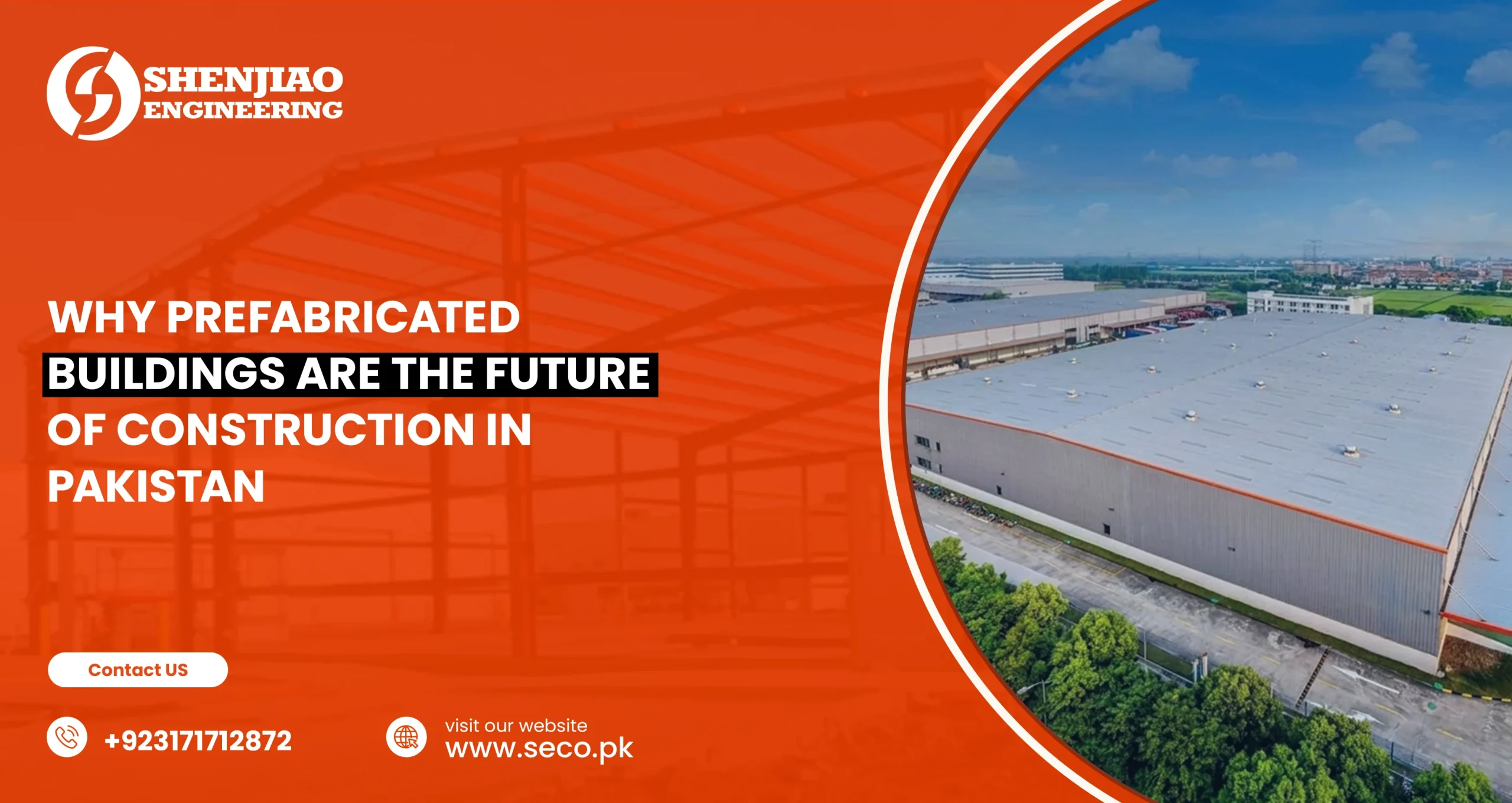
Why Prefabricated Buildings Are the Future of Construction in Pakistan
There is a quiet revolution happening in how Pakistan builds. It does not involve a single dramatic announcement or a single headline-grabbing project. It is happening project by project, city by city in industrial estates, logistics parks, and commercial zones across the country. It is the rise of prefabricated construction.
What Prefabrication Actually Means
Prefabricated buildings or prefab buildings are structures whose key components are manufactured in a controlled factory environment and then transported to the construction site for assembly. Rather than building everything on-site from raw materials, the heavy lifting of fabrication happens off-site under precise, quality-controlled conditions.
The result is a building that goes up faster, with more consistent quality, less waste, and fewer weather-related delays than a conventionally constructed structure.
This is not a new concept globally. In Europe, North America, Japan, and China, prefabricated construction has been mainstream for decades. What is new is its growing adoption in Pakistan and the reasons for that adoption are very practical.
Speed: The Advantage That Changes Everything
In construction, time is rarely just a scheduling issue it is a financial one. Every week a factory is not operational, every month a warehouse sits unfinished, represents real cost. Delays compound. Contracts get strained. Revenue gets deferred.
Prefabricated construction dramatically compresses project timelines. Because fabrication happens in the factory simultaneously with site preparation, the two processes run in parallel rather than sequentially. By the time the site is ready, the building components are already waiting to be assembled.
For Pakistan’s fast-moving industrial and commercial sectors, this speed advantage is not just convenient — it is often decisive. Businesses that need to be operational by a specific date, that are managing tight investment cycles, or that simply cannot afford the unpredictability of traditional construction timelines find prefab an enormously attractive option.
Consistent Quality Through Factory Conditions
On-site construction is subject to variables that are difficult to control: weather, the skill level of individual workers on any given day, material inconsistencies, and the inherent complexity of coordinating dozens of trades in an open environment.
Factory fabrication eliminates most of these variables. Components are produced under controlled conditions, with standardized processes, quality checks at every stage, and machinery that applies tolerances no human hand can consistently achieve.
The result is structural components that are dimensionally precise, consistently finished, and built to specifications that will be the same on the hundredth unit as they were on the first. When those components arrive on site, they fit. Assembly proceeds smoothly. The finished building is exactly what the design called for.
Reduced Waste and Environmental Impact
Construction is one of the world’s most wasteful industries. On a conventional building site, significant quantities of materials steel offcuts, concrete waste, timber scraps — end up as debris that must be disposed of.
Prefabricated construction is fundamentally more efficient. Materials are used precisely, ordered in the exact quantities needed, and cut with minimal waste in factory conditions where offcuts can be reused or recycled systematically.
For developers and businesses increasingly conscious of their environmental footprint, this efficiency matters. It reduces disposal costs, reduces the environmental burden of the project, and aligns with the growing global expectation that responsible construction means responsible resource use.
Flexibility and Scalability
One of prefab construction’s less-discussed advantages is its scalability. Because components are modular and standardized, expanding a prefabricated building is far more straightforward than expanding a conventional one.
A business that builds a prefab factory today can, in a few years, add a new bay, extend a production floor, or attach a new storage wing with minimal disruption to operations. The structural system is designed to accommodate growth.
This flexibility makes prefab construction a particularly smart long-term investment for businesses in growth phases — which describes a significant portion of Pakistan’s industrial and commercial sector right now.
SECO’s Prefabricated Building Solutions
SECO has built its prefabricated building capabilities around the needs of Pakistani industrial and commercial clients. Our manufacturing processes combine internationally refined techniques with deep familiarity with local conditions climate, seismic considerations, logistics infrastructure, and the practical realities of construction across Pakistan’s diverse geography.
We handle the full cycle: structural design, component fabrication, transportation, and on-site assembly. Our team ensures that every building we deliver is not just structurally sound but operationally functional built for the real conditions it will face.
Whether you are building a manufacturing facility in Lahore, a logistics hub near a major highway, or a commercial structure in any of Pakistan’s growing urban centres, prefabricated construction offers a compelling combination of speed, quality, and long-term value.
The Future Is Already Here
The shift toward prefabricated construction in Pakistan is not speculative it is already well underway. The businesses and developers who are adopting it now are gaining real competitive advantages: faster deployment, more predictable costs, and buildings that perform to international standards.
As Pakistan’s economy continues to develop and infrastructure demands continue to intensify, prefab construction will move from an innovative choice to a mainstream one.
SECO is ready to build that future with you. Visit seco.pk to start the conversation.