


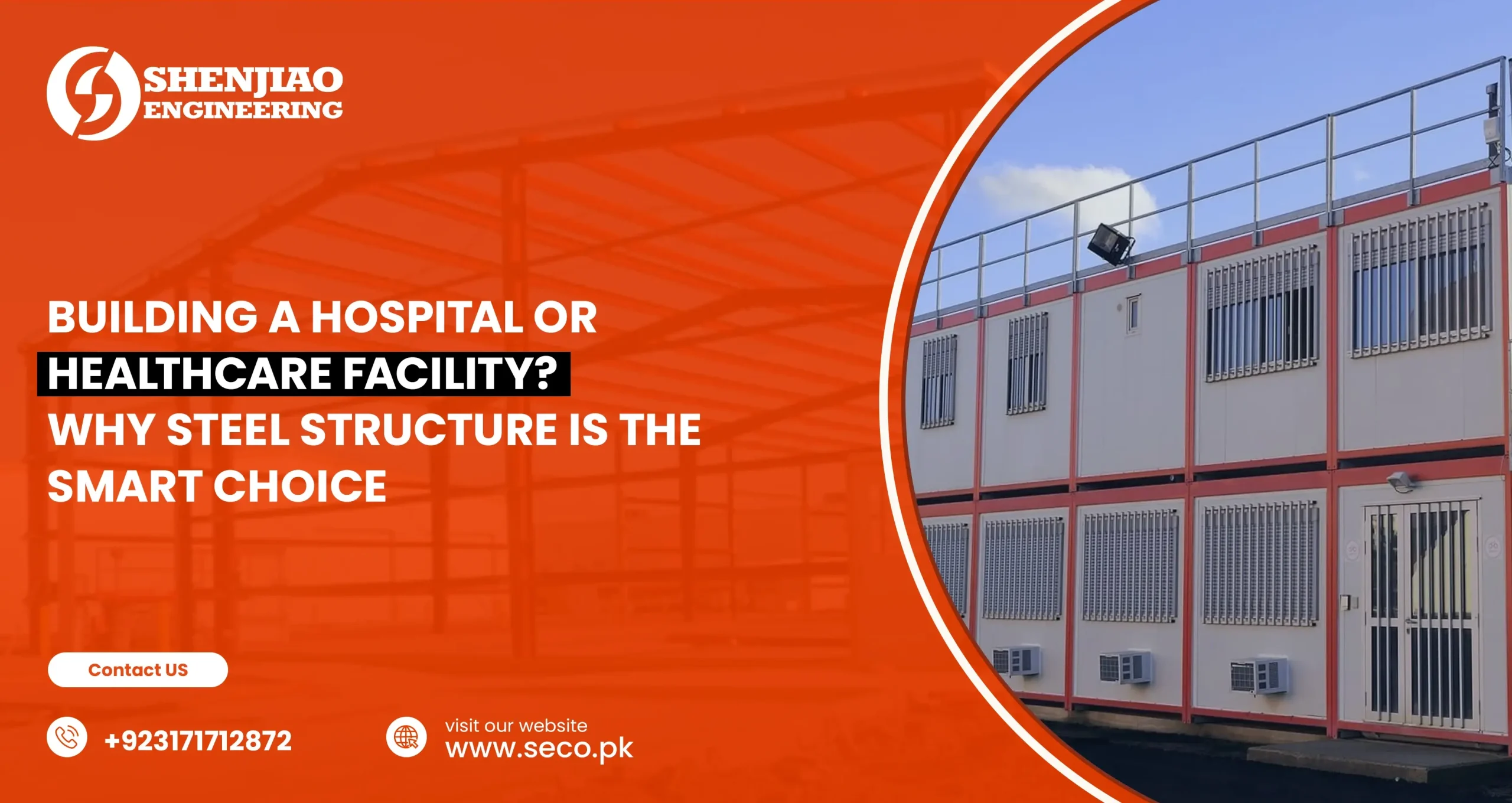
Building a Hospital or Healthcare Facility? Why Steel Structure Is the Smart Choice
Healthcare infrastructure in Pakistan is under enormous pressure. A population of over 230 million is served by a healthcare system that has chronically struggled to keep pace. Hospital bed capacity falls well short of recommendations and while private healthcare investment has grown, the pace of new facility construction still lags behind demand.
When a hospital, clinic, diagnostic centre, or healthcare facility needs to be built in Pakistan, two things matter most: speed and quality. Patients cannot wait for a two year construction project. And a healthcare facility cannot afford to compromise on structural safety, hygiene, or the flexibility to adapt as medical technology evolves.
This is precisely why steel structures have become the construction method of choice for forward thinking healthcare developers and hospital builders in Pakistan.
The Unique Construction Demands of Healthcare Facilities
Before getting into why steel works so well, it is worth understanding what makes hospital construction genuinely different from other building types.
- Infection control: Every material and surface in a healthcare facility must support rigorous hygiene protocols. Surfaces must be non-porous, smooth, and cleanable.
- Flexibility and adaptability: Medicine advances rapidly. A building that cannot be easily reconfigured as clinical needs change becomes an obstacle to quality patient care.
- Structural reliability: A hospital must remain operational in emergencies including earthquakes. The structure must be robust and seismically sound.
- Speed of delivery: Healthcare need does not wait. In the private sector, construction delays translate directly into delayed revenue and increased financing costs.
- MEP integration: Hospitals are services intensive. Medical gases, HVAC, fire suppression, and IT infrastructure run throughout the building in extraordinary density.
7 Reasons Steel Structures Are Ideal for Hospitals and Healthcare Facilities
1 Speed of Construction Getting Facilities Operational Faster
Pre-engineered steel structures can be designed, fabricated, and erected in a fraction of the time required for conventional concrete frame construction. In Pakistan where private hospitals are expanding rapidly, pre-engineered steel construction offers a genuine competitive advantage by getting doors open sooner.
2 Seismic Safety Hospitals Must Remain Standing
Steel structures are significantly more earthquake resistant than masonry or poorly detailed concrete construction. This matters especially for hospitals. In a seismic event, a hospital is needed most precisely when the ground is shaking. If the hospital itself collapses, the community loses its capacity to respond to the disaster.
3 Large Clear Spans Flexible Floor Plans
Modern hospital design requires large, unobstructed floor plates. Columns in the middle of wards, operating theatres, or emergency departments create clinical workflow problems. Pre-engineered steel structures routinely achieve clear spans of 20 to 30 metres, allowing floor plans to be designed entirely around clinical function.
4 Compatibility with Modern Building Services
Hospitals require extraordinary density of building services like HVAC systems and medical gas pipelines. Steel framed structures accommodate this complexity better than traditional masonry. Services can be routed through the open steel frame and easily accessed for maintenance and modification.
5 Hygienic Construction Process
Traditional wet construction like bricklaying and plastering generates enormous quantities of dust and moisture. Pre-engineered steel construction is a far cleaner and drier process. Structural members arrive on site pre-fabricated and are bolted together, which is a major advantage when building adjacent to existing clinical areas.
6 Long-Term Adaptability
A hospital built today will serve its community for 50 years or more. Steel structures can be modified, extended, and reconfigured far more easily than concrete. Additional floors can be added to a steel frame that was designed for future vertical expansion, and internal layouts can be changed without structural demolition.
7 Cost-Effectiveness Without Compromising Quality
Healthcare budgets in Pakistan are always under pressure. Pre-engineered steel construction typically offers significant cost savings compared to conventional RCC frame construction through lighter foundations, faster construction, and less site labour.
Types of Healthcare Facilities Suited to Steel Construction
Steel structures are appropriate for a wide range of healthcare building types in Pakistan:
- General and specialist hospitals: Multi-floor steel framed structures designed for seismic resistance.
- Diagnostic and imaging centres: Accommodating shielding requirements and heavy equipment loads like MRI and CT scanners.
- Day surgery and outpatient clinics: Where speed of construction and clean interiors are priorities.
- Hospital expansions: Adding new wings with minimal disruption to ongoing clinical operations.
- Modular healthcare facilities: For disaster response or remote area healthcare where facilities are needed in weeks.
What Good Healthcare Construction Looks Like: Key Principles
Whether you are working with SECO or another contractor, here are the principles that should guide any healthcare facility construction project in Pakistan:
- Engage clinical input early: Clinical workflows and infection control protocols should drive the floor plan.
- Prioritise seismic design: In Pakistan this is non-negotiable. Verify that your structural engineer has designed for seismic loads.
- Plan for MEP coordination: Services coordination is where most projects encounter delays. Structural and MEP design must proceed in parallel.
- Design for future flexibility: Invest in slightly more structural capacity and ceiling voids than you think you need today.
SECO Approach to Healthcare Construction
At Shenjiao Engineering Company (SECO), we bring the engineering expertise and fabrication capacity needed to deliver steel structures for healthcare facilities in Pakistan. We understand that healthcare projects carry a higher standard of responsibility. We bring engineering rigour and quality fabrication to every healthcare project we undertake.
From structural design through to erected structure, SECO manages the full steel package allowing healthcare developers to focus on the clinical fit out elements of their project.
Contact SECO for a free quote and let us talk about how steel construction can accelerate your healthcare project.
Frequently Asked Questions (FAQ)
Are steel structure hospitals safe for patients and staff? Yes. When properly designed and constructed, steel hospitals are among the safest building types available globally due to their seismic resistance and structural reliability.
Can a steel structure hospital be built to multiple floors? Yes. SECO designs and fabricates multi-storey steel-framed structures. Floor heights and vertical expansion capacity can all be planned from the outset.
How does steel construction compare to RCC for hospital construction in Pakistan? For medium to large healthcare facilities, steel is typically faster to construct, lighter on foundations, and more adaptable over the building lifetime compared to RCC.
What is the typical construction timeline for a steel-framed hospital building? A single-storey outpatient centre can be structurally complete in 8 to 14 weeks. A multi-storey hospital building requires more time but is still typically faster than equivalent RCC construction.
Does SECO have experience with healthcare projects specifically? Our steel structure expertise spans industrial, commercial, and institutional projects. Contact us at info@seco.pk or call 0317-1712872 to discuss your specific healthcare project requirements today.
Shenjiao Engineering Company (SECO) is a leading pre-engineered steel structure company in Pakistan, based in Lahore. We specialise in steel structures, prefabricated buildings, roofing systems, and container houses.