


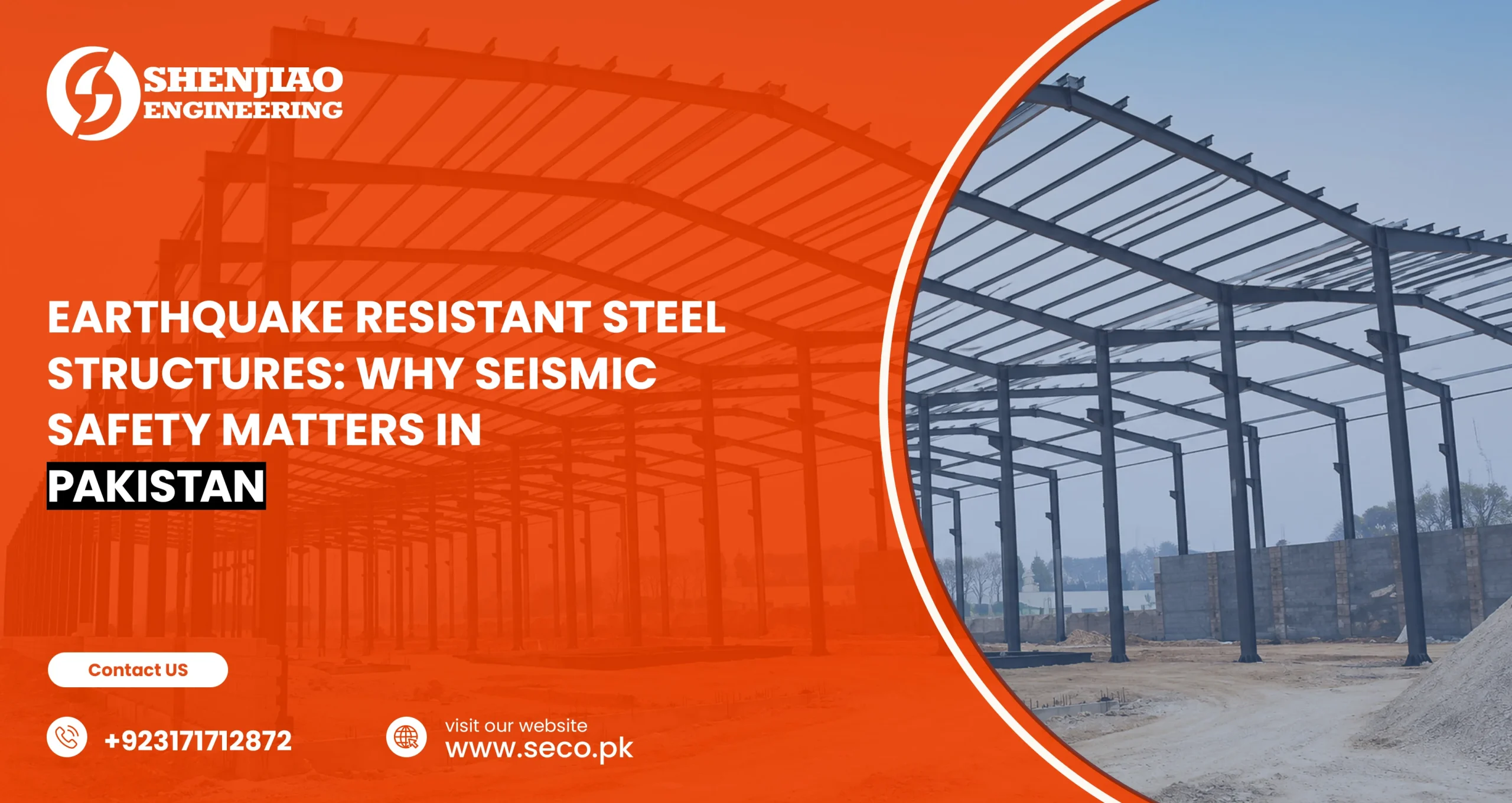
Earthquake Resistant Steel Structures: Why Seismic Safety Matters in Pakistan
On the 8th of October 2005, a 7.6 magnitude earthquake struck Azad Kashmir and northern Pakistan. Over 87,000 people lost their lives. Entire cities were reduced to rubble. The vast majority of deaths were caused not by the earthquake itself, but by the collapse of buildings
That tragedy was almost two decades ago But Pakistan seismic risk has not gone away Awareness should be higher than ever because the right construction choices can mean the difference between a building that stands and one that kills
If you are planning a factory, warehouse, or commercial building in Pakistan, seismic safety is not optional It is a fundamental design requirement Pre-engineered steel structures are one of the most earthquake resistant building systems available
Pakistan Seismic Reality: A Country on Active Fault Lines
Pakistan sits at the convergence of three major tectonic plates: the Indian Plate, the Eurasian Plate, and the Arabian Plate This makes it one of the most seismically active countries in the world
The country is divided into seismic zones, with the highest risk areas including:
- Azad Kashmir and Khyber Pakhtunkhwa: Near the Himalayan collision zone where the 2005 quake struck
- Balochistan: Regularly experiences significant activity, including the 7.7 magnitude 2013 Awaran earthquake
- Northern Punjab: Including areas near Lahore, which sits near known fault systems
- Sindh and coastal areas: At lower but non-negligible risk
The question is not whether seismic risk exists in Pakistan It does, almost everywhere The question is whether your building is designed to handle it
Why Traditional Masonry Buildings Fail in Earthquakes
To understand why steel structures perform so well, it helps to understand why traditional construction fails
Brick and concrete block buildings are heavy and brittle When seismic waves hit, these materials cannot flex, they crack and collapse The weight of the structure itself becomes lethal Even reinforced concrete buildings, if not properly detailed for seismic loads, can fail catastrophically Poor construction quality and non-compliant concrete mixes are common in the informal sector
How Steel Structures Resist Earthquake Forces
Steel has physical properties that make it inherently better suited to seismic conditions than masonry:
1 Ductility: The Ability to Bend Without Breaking
Ductility is the most important property in seismic design It refers to a material ability to deform significantly before fracturing Steel is one of the most ductile structural materials available A well-designed steel frame can bend and absorb energy without suddenly fracturing
2 Lightweight Structure: Less Seismic Force
Seismic force is directly proportional to the mass of the building The heavier the structure, the greater the forces generated when the ground shakes A steel building is significantly lighter than an equivalent concrete structure, meaning less inertial force during an earthquake
3 Uniform and Predictable Strength
One challenge with site-mixed concrete in Pakistan is quality control Structural steel is manufactured under controlled factory conditions to precise specifications Its strength and behavior under load are known and predictable
Seismic Design in Practice: What Should Be Specified
Proper seismic design involves:
- Site-specific hazard assessment: Design should be based on the seismic zone classification for your specific location in Pakistan
- Proper connection detailing: Connections must be detailed to allow ductile behavior without premature failure
- Foundation design: The foundation must be designed to transfer seismic forces safely into the ground
- Lateral load resisting system: Whether moment frames or braced frames, the system must be explicitly designed for sideways forces
Steel Structures After an Earthquake: Inspectable and Repairable
One overlooked advantage is what happens after an earthquake Damage to a steel building, such as deformed connections or loose bolts, is visible and inspectable An engineer can determine if the building is safe to reoccupy or what repairs are needed
Concrete damage is often invisible until it is catastrophic Internal cracks and rebar issues may not be apparent until a subsequent earthquake causes complete collapse
SECO Approach to Structural Safety
At Shenjiao Engineering Company (SECO), structural safety is built into every project from day one
Our engineering team designs all structures in accordance with the Building Code of Pakistan (BCP) and international standards We consider the seismic zone of every project location and design accordingly Our fabrication facility in Lahore ensures steel members are produced to specification and our erection teams follow engineering drawings precisely
If you want the confidence that your building is designed to withstand Pakistan geology, talk to our team
Frequently Asked Questions (FAQ)
Is Lahore in a seismic zone? Yes The Building Code of Pakistan classifies Lahore in a moderate seismic zone, and design must account for this
Are all steel buildings earthquake resistant? Not automatically The material has excellent properties, but the building must be properly engineered and constructed Always work with a qualified firm
What is the Building Code of Pakistan (BCP)? The BCP includes seismic provisions based on international standards It defines seismic zones across Pakistan and specifies design requirements for each
Can an existing building be made more earthquake resistant? Yes, through seismic retrofitting which typically involves adding steel frames or bracing to existing structures
Shenjiao Engineering Company (SECO) is a leading steel structure company in Pakistan, based in Lahore We specialise in pre-engineered buildings and roofing systems that are safe, durable, and built to code
Contact us at info@seco.pk or call 0317-1712872 to discuss your project today