


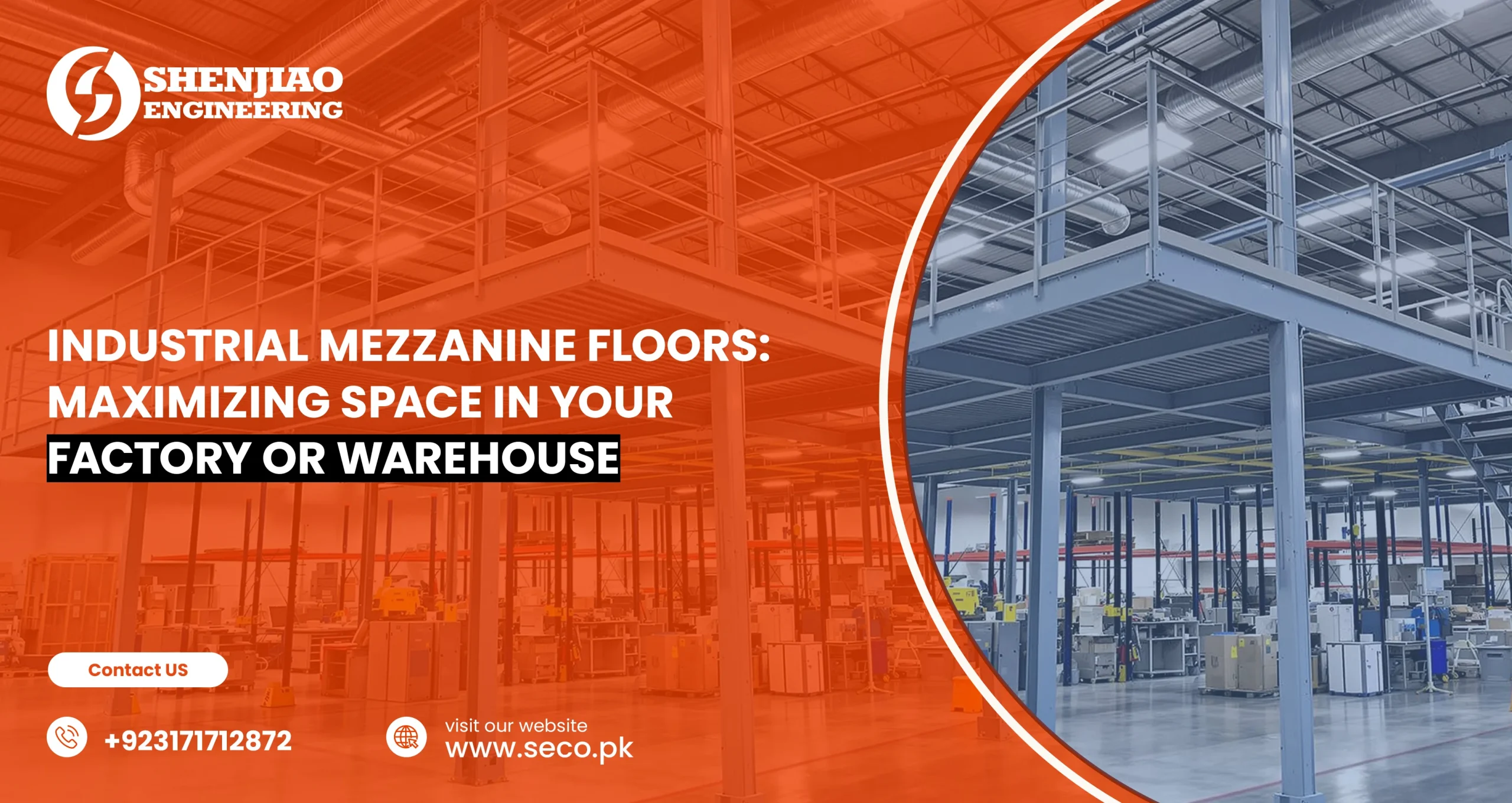
Industrial Mezzanine Floors Maximizing Space in Your Factory or Warehouse
Space is one of the most expensive things in any business. Whether you are running a factory in Lahore industrial zone or a distribution warehouse in Karachi, the floor space you have directly limits what you can produce, store, and grow.
When most business owners run out of space, their first instinct is to either rent a second building or build an extension. Both options are costly and slow.
There is a smarter solution: building upward instead of outward.
An industrial mezzanine floor lets you create an entirely new level of usable space inside your existing structure without expanding the footprint and in a fraction of the time it takes to build a new facility.
What Is an Industrial Mezzanine Floor
A mezzanine floor is an intermediate level built between the floor and ceiling of an existing building. In industrial settings, these are typically steel framed structures supported by columns with a decking surface capable of carrying heavy loads.
Unlike a permanent second floor, a steel mezzanine is:
- Freestanding: It does not rely on the existing building structure for support.
- Modular: It can be expanded, reconfigured, or relocated if your needs change.
- Fast to install: Most mezzanines can be installed in days to a few weeks with minimal disruption.
- Cost-effective: Typically a fraction of the cost of building an extension.
What Can You Use a Mezzanine Floor For
A mezzanine floor is not just for storage. Here are the most common uses in Pakistani industrial settings:
Additional Storage Space
If your warehouse floor is full, a mezzanine doubles your storage capacity. Racking systems can be installed on the mezzanine level, and goods can be moved via a goods lift.
Office Space Above the Factory Floor
Many factory owners need office space for supervisors or accounts but do not want to dedicate valuable ground floor area to it. A mezzanine office solves this perfectly.
Production or Assembly Areas
For light assembly or quality control, a mezzanine can serve as a dedicated production zone. This allows you to vertically separate different production stages within the same building.
Staff Facilities
Canteens, prayer rooms, and rest areas for factory staff can be housed on a mezzanine, freeing the ground floor entirely for productive use.
Key Components of a Steel Mezzanine Structure
Columns: The vertical steel posts that carry the load of the mezzanine down to the floor.
Primary Beams: The main horizontal beams that span between columns.
Secondary Beams: Smaller beams that support the decking directly.
Decking: The surface you walk on. Options include steel grating or chequer plate steel.
Staircase: Industrial staircases are typically steel with non-slip treads and handrails.
Handrails: Required around all open edges for safety.
Load Capacity: Getting the Specification Right
This is one of the most critical aspects of mezzanine design. Mezzanine floors are designed for a specific live load:
- 300 kg/m²: Light storage or offices.
- 500 kg/m²: Medium storage or light production.
- 750 kg/m²: Heavy storage with racking.
- 1,000 kg/m² and above: Very heavy industrial loads.
Always be honest with your supplier about what you plan to put on the mezzanine as underspecifying the load is a safety risk.
What Height Do You Need for a Mezzanine
For a mezzanine to be functional, you need enough clear height on both levels:
- You need at least 4.5 to 5 metres of clear internal height to install a useful mezzanine.
- The mezzanine deck is typically installed at 2.4 to 3 metres above floor level.
- Headroom above the mezzanine deck should ideally be at least 2.1 to 2.4 metres.
Most industrial steel buildings in Pakistan with eave heights of 6 metres and above are well suited for mezzanine installation.
SECO Approach to Industrial Mezzanine Floors
At Shenjiao Engineering Company (SECO), we design and fabricate industrial mezzanine floors as part of our wider steel structure capability. Whether you need a mezzanine inside a new structure or retrofitted into your existing facility, our team manages the full process.
From structural design by qualified engineers to fabrication at our Lahore facility, we ensure your mezzanine is built to last.
Contact SECO for a free quote and let us talk about how you can double your usable space.
Frequently Asked Questions (FAQ)
How much does a mezzanine floor cost in Pakistan? Cost depends on size and load specification. Steel mezzanine floors in Pakistan typically range from PKR 4,000 to PKR 9,000 per square foot of mezzanine area.
How long does it take to install a mezzanine floor? A small to medium mezzanine can typically be installed in one to three weeks once fabrication is complete.
Can a mezzanine be installed without shutting down my factory? Yes. Our installation teams are experienced in working around live operations to minimise disruption.
Can a mezzanine be removed or relocated if I move premises? Yes. This is one of the key advantages of steel mezzanines over permanent construction.
My building has a concrete slab floor — can it support a mezzanine? It depends on the slab thickness. A structural engineer needs to assess the existing slab before installation to confirm it can carry the column point loads.
Shenjiao Engineering Company (SECO) is a leading steel structure company in Pakistan, based in Lahore. We specialise in pre-engineered buildings, roofing systems, and industrial mezzanine floors.
Contact us at info@seco.pk or call 0317-1712872 to discuss your project today.