


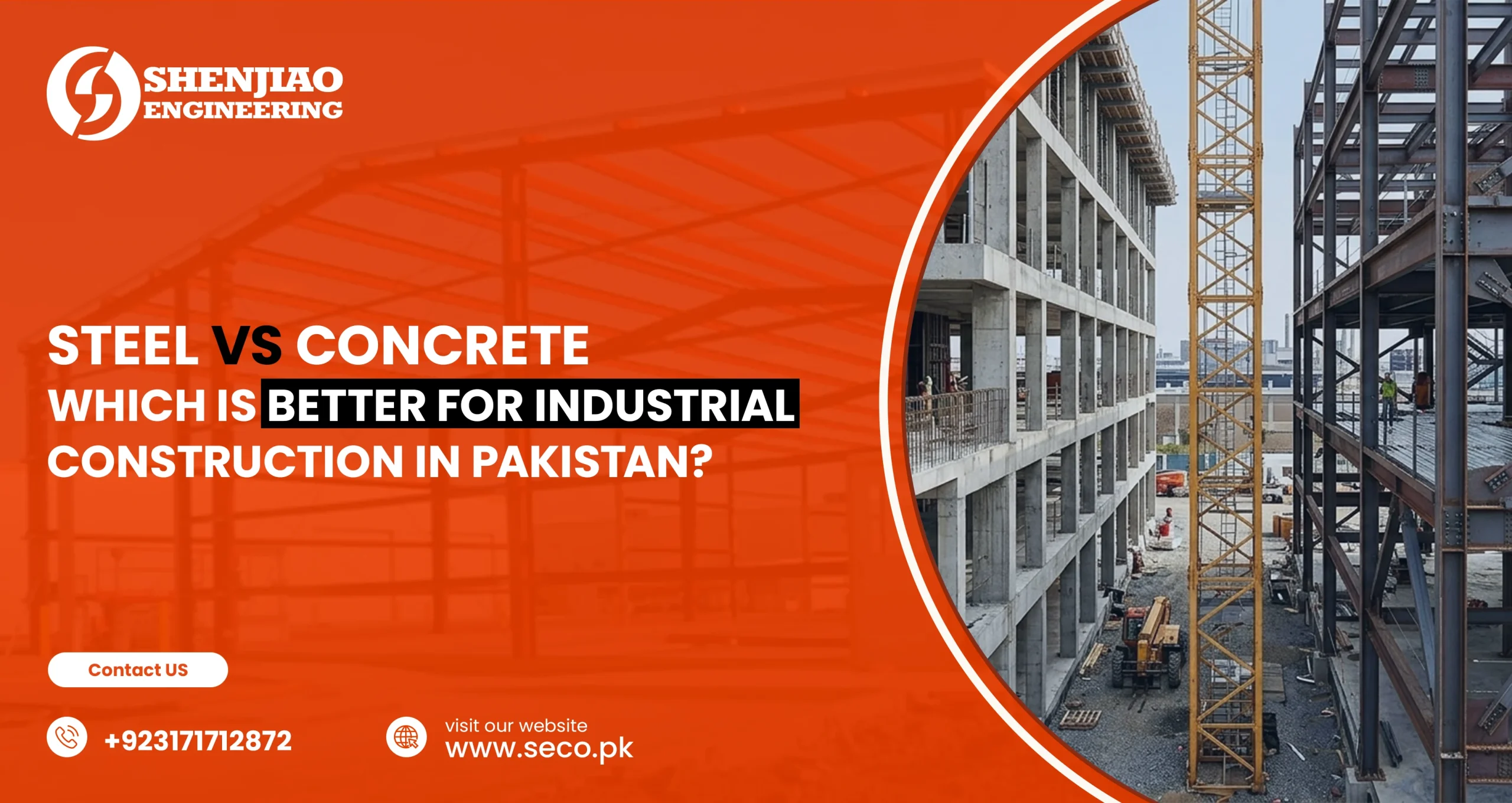
Steel vs. Concrete: Which Is Better for Industrial Construction in Pakistan?
It is one of the most common questions in industrial construction: should we build in steel or concrete? Both materials have been used to construct industrial buildings across Pakistan for decades. Both have genuine strengths. And the right answer depends as it always does in engineering on the specifics of the project at hand.
The Case for Steel
Structural steel offers a set of advantages that make it the material of choice for a significant proportion of industrial construction globally and increasingly in Pakistan.
Speed of construction is the most frequently cited advantage. Steel components are fabricated in a factory and arrive on site ready to be assembled. A steel-framed industrial building can be erected in a fraction of the time required for an equivalent concrete structure. For businesses facing commercial deadlines or investment timelines, this speed difference is often decisive.
Clear-span capability is another major steel advantage. Steel can bridge wide distances without intermediate supports, enabling the open floor plans that manufacturing and logistics operations require. The ability to design a 40-metre clear span, or to hang overhead cranes from a steel roof structure, is something concrete simply cannot match as efficiently.
Steel is also lighter than concrete for equivalent structural capacity. This reduces the load on foundations, which can translate into simpler, less expensive foundation design particularly valuable on sites with variable soil conditions.
Adaptability is a further steel strength. Adding new bays to a steel-framed building, modifying wall positions, or installing new structural elements is far more practical with steel than with concrete. For industrial operations that evolve over time, this flexibility has significant long-term value.
Finally, steel is fully recyclable at the end of a building’s life a sustainability characteristic that matters increasingly to environmentally conscious developers and businesses.
The Case for Concrete
Concrete has its own set of properties that make it the right choice for certain industrial applications. Understanding these honestly is important no material is universally superior.
Thermal mass is one of concrete’s genuine advantages. Concrete absorbs and retains heat, moderating internal temperature fluctuations. For certain manufacturing processes sensitive to temperature variation, or for buildings in regions with extreme diurnal temperature swings, this thermal performance can be valuable.
Concrete performs well under sustained compressive loads which is why it is the standard material for foundations, ground slabs, and retaining structures regardless of what framing material is used above.
In environments with very high chemical exposure certain chemical processing facilities, for instance concrete formulations can be specified to resist corrosive substances that would degrade steel without expensive coating systems.
Concrete also has strong local supply chains across Pakistan. Aggregate, cement, and ready-mix concrete suppliers are present in virtually every major construction market in the country. In very remote locations where transporting fabricated steel is difficult, concrete’s local availability can tip the balance.
Where Steel Typically Wins for Industrial Use
For most industrial construction scenarios in Pakistan factories, warehouses, logistics facilities, workshops, and light manufacturing plants steel comes out ahead on the key decision criteria.
Construction speed is almost always faster with steel. The controlled factory fabrication of components means quality is consistent and the assembly process on site is more predictable than concrete pours, which are subject to curing times, weather, and quality variability.
Clear spans, which are essential for most industrial operations, are more economically achieved in steel. The structural efficiency of steel under tension and bending loads allows engineers to design spans that would require impractically heavy concrete beams.
For buildings that need to accommodate heavy overhead cranes a standard requirement in many manufacturing and engineering facilities — steel roof trusses and columns provide the structural basis far more naturally than concrete equivalents.
Lifecycle adaptability matters in industrial construction. Businesses grow, processes change, and buildings need to change with them. Steel-framed buildings accommodate these changes far more readily than concrete ones.
A Hybrid Approach: The Practical Reality
In practice, most industrial construction projects in Pakistan use both materials just in different roles. Concrete is used for foundations, ground floor slabs, retaining walls, and occasionally for fire-rated cores. Steel is used for the main structural frame, roof structure, and spanning elements.
This hybrid approach takes the best of both materials. Concrete’s compressive strength and local availability make it the right choice for ground-bearing structures. Steel’s speed, span capability, and adaptability make it the right choice for everything above ground.
SECO’s approach to industrial construction is built around this practical understanding. We work with structural engineers to optimise the use of both materials across a project, ensuring that clients get the right solution not just a preference for one material over another.
Making the Decision for Your Project
The steel versus concrete question is ultimately a project-specific one. The right answer depends on what you are building, where, on what timeline, and for what operational purpose.
What is clear for most industrial construction in Pakistan is that steel framing offers compelling advantages in speed, span, adaptability, and long-term lifecycle value. These advantages are why steel structure buildings are growing rapidly as a proportion of industrial construction across the country. SECO has the engineering capability and experience to help you make the right structural decision for your project. Contact us at seco.pk to discuss your specific requirements