

Bolted vs Welded Connections in Steel Structures: Which Is Better and When?
The connections are where a steel structure really comes together. Beams and columns can be perfectly designed, but if the joints between them are weak or poorly made, the whole building suffers. The two main ways of joining steel are bolting and welding, and people often ask which one is better. The honest answer is that each has its place.
Bolted connections
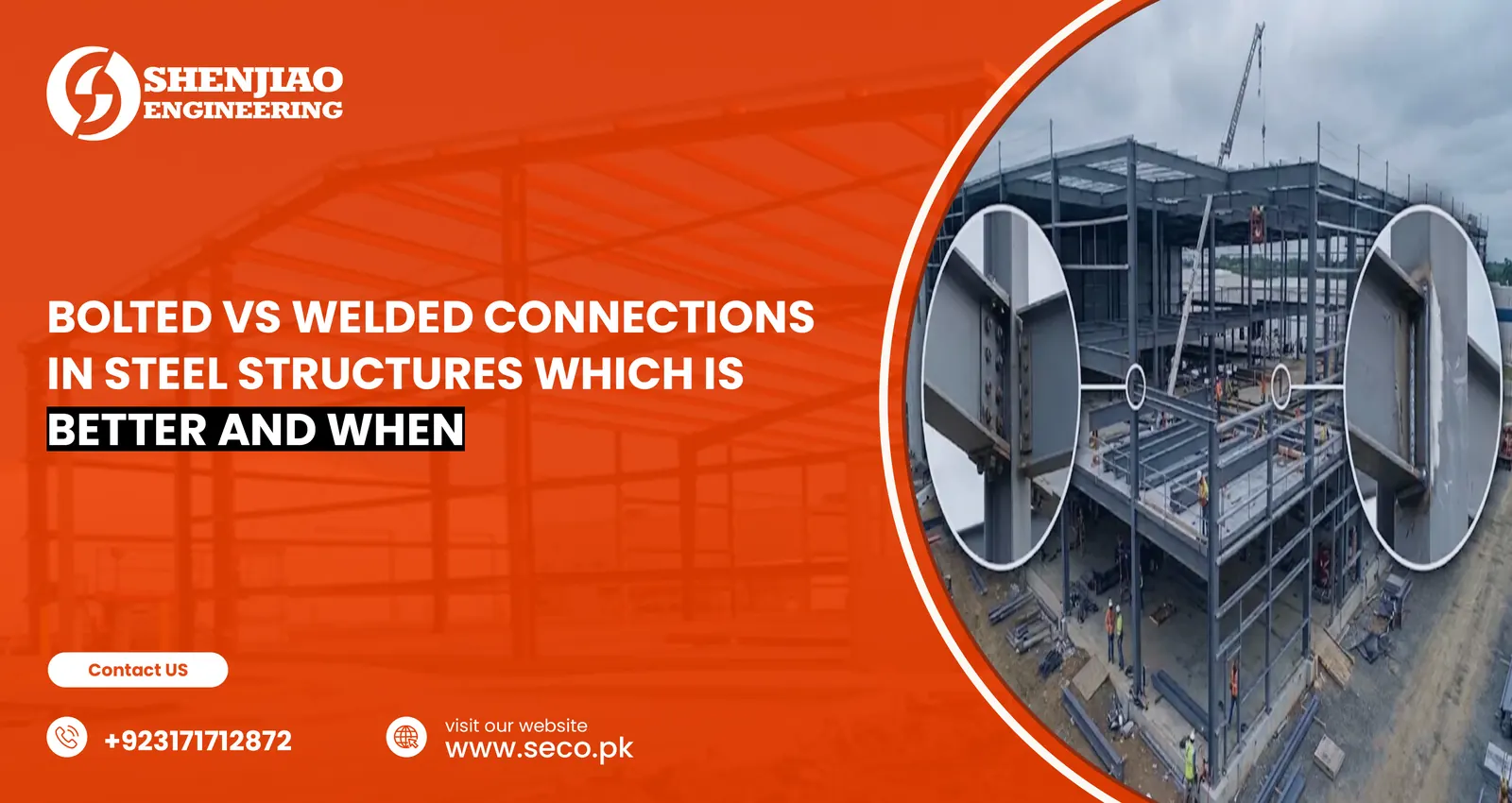
In a bolted connection, steel members are joined using high strength bolts, nuts and washers that pass through holes drilled in plates or flanges. In structural work, these are usually high strength grades. Depending on the design, bolts can be tightened to a specified level so that the joint resists load through friction, or they can work in bearing.
Advantages of bolting
- Fast and clean to install on site, with no need for heavy welding equipment.
- Less dependent on weather, since rain or wind does not affect bolt tightening the way it affects welding.
- Easier to inspect, because tightness and bolt count can be checked visually and with torque tools.
- Easy to dismantle, which helps when a building needs to be relocated, extended or modified.
- Less risk of heat distortion in the steel.
Limitations of bolting
- Holes slightly reduce the section area, which must be accounted for in design.
- Joints may need extra plates or larger connection areas.
- Poor hole alignment can slow erection.
- Loose or under tightened bolts can become a hidden weakness if not checked.
Welded connections
Welding joins steel by melting the metal at the joint and adding filler material, so the pieces fuse into one. When done by qualified welders following approved procedures, a welded joint can be as strong as the steel itself.
Advantages of welding
- Strong, continuous joints that transfer load efficiently.
- Clean appearance, which is useful for exposed architectural steel.
- Flexible for complex shapes and custom connections.
- Very good for built-up sections, such as the tapered I-shaped members used in pre-engineered buildings.
Limitations of welding
- Quality depends heavily on welder skill and procedure control.
- Weather, wind and dirt can affect site welding.
- Heat can cause distortion or residual stresses.
- Inspection is more demanding, often needing visual checks and sometimes non destructive testing.
- Modification or dismantling later is difficult.
Shop welding vs field welding
This difference is very important. Welding done inside a factory is carried out in controlled conditions, with good positioning, lighting and quality checks. Welding done on a construction site is exposed to wind, dust, uneven positions and time pressure. Because of this, good practice is to do as much welding as possible in the shop and to rely on bolting for site connections.
How most modern structures do it
Most steel buildings, especially pre-engineered ones, follow a simple rule. Weld in the factory and bolt on site. Columns and rafters are fabricated with welded plates in a controlled environment, then connected at site using bolted end plates. This approach combines the strength and flexibility of welding with the speed and simplicity of bolting.
Choosing the right option
Bolted connections are usually better when:
- Speed of erection is a priority.
- The structure may be extended, relocated or modified in the future.
- Site conditions are not ideal for welding.
- You want easy inspection.
Welded connections are usually better when:
- The joint is complex or custom shaped.
- A continuous, rigid connection is needed.
- Work can be done in a factory under controlled conditions.
- Appearance matters for exposed steel.
Quality matters more than the type
A good bolted joint beats a bad welded joint, and a good welded joint beats a bad bolted joint. What matters is the quality of design, materials, workmanship and inspection. Ask your contractor which standards they follow, how welders are qualified, how bolts are tightened and checked, and what inspection records they keep.
Final thoughts
The question is not really which method is better. It is which method is right for each joint in your building. A well planned structure uses both, in the right place, with proper inspection. That balance gives you safety, speed and long term durability.