


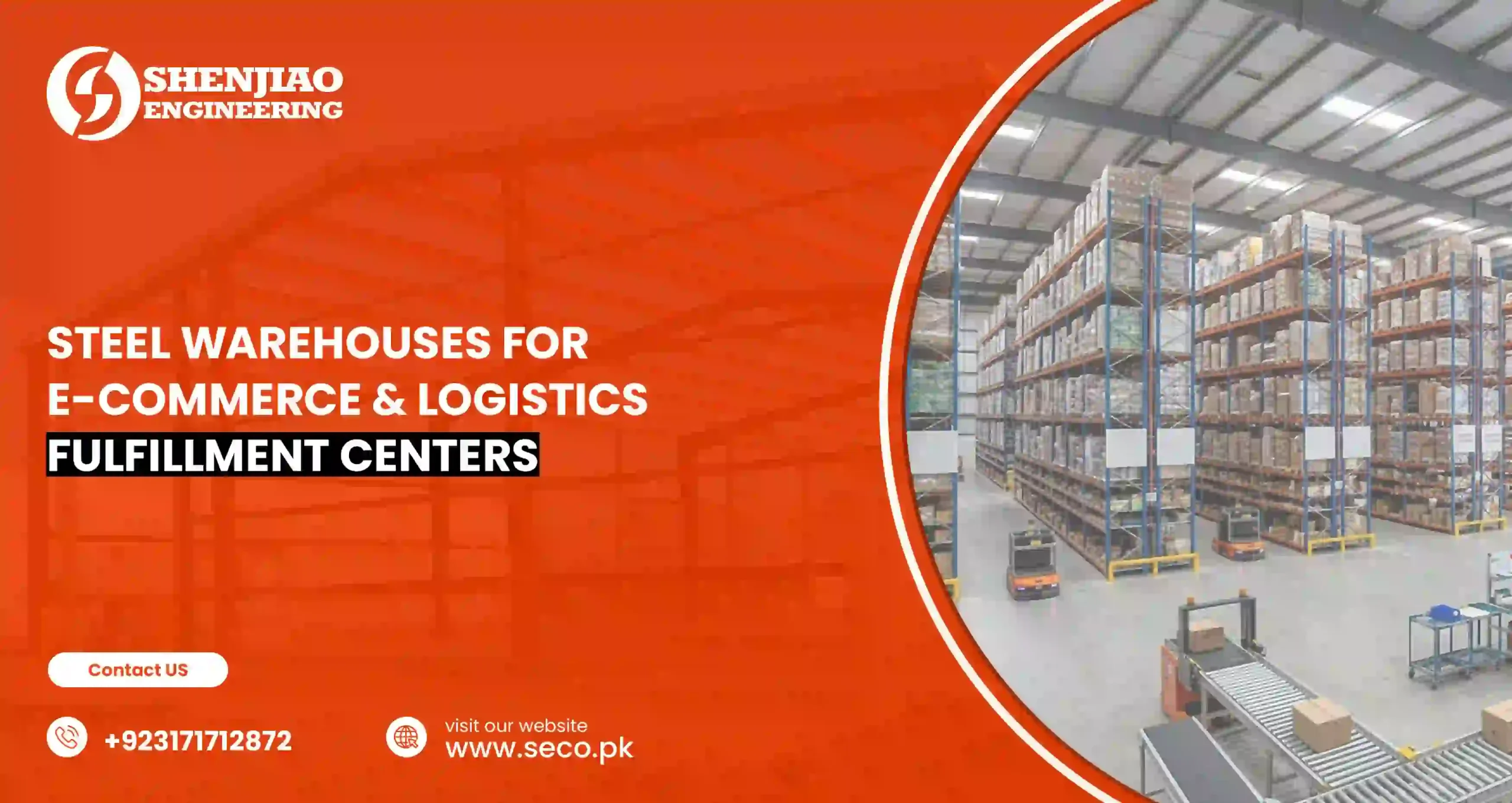
Steel Warehouses for E-commerce & Logistics Fulfillment Centers
Introduction
Pakistan’s e-commerce sector has grown rapidly, and with it, the demand for fulfillment centers, sorting hubs, and distribution warehouses capable of handling high inventory turnover. Speed of construction and operational flexibility matter as much as storage capacity for these facilities. Pre-engineered steel warehouses have become the go-to solution for logistics operators who need to scale quickly without compromising on functionality.
Why E-commerce and Logistics Operators Choose Steel
Speed to operation. In e-commerce, time lost waiting for a facility to be built is time lost to competitors. Pre-engineered steel warehouses can be designed, fabricated, and erected significantly faster than conventional construction, letting fulfillment operations begin sooner.
Clear span storage space. Automated sorting systems, conveyor lines, and high-density racking all benefit from open floor plans free of interior columns. Steel portal frame construction easily achieves the wide clear spans that modern warehouse operations require.
Scalability. Many e-commerce and logistics businesses design their first facility with future expansion in mind. Steel structures can be planned with modular bays, making it straightforward to extend a warehouse as order volumes grow.
High roof clearance for racking. E-commerce fulfillment centers often use tall pallet racking or mezzanine storage to maximize vertical space. Steel structures accommodate greater eave heights more economically than masonry alternatives.
Design Features That Matter for Fulfillment Centers
- Dock-level loading bays designed around the specific truck and container traffic the facility expects
- Mezzanine floors for packing stations, returns processing, or additional storage without expanding the building footprint
- Wide bay spacing to accommodate racking layouts and forklift or automated guided vehicle movement
- Insulated roofing where temperature-sensitive inventory is stored
- Ample natural lighting through skylights to reduce daytime energy costs across large floor areas
Planning for Growth
One advantage of working with an experienced PEB provider is the ability to plan a facility that grows with the business. SECO designs warehouse structures with expansion bays and foundation planning that anticipate future additions, so a fulfillment center built today can add capacity later without a complete structural overhaul.
Applications Beyond E-commerce
The same design principles apply to third-party logistics providers, cold chain and temperature-controlled distribution centers, retail distribution and cross-docking facilities, and courier and parcel sorting hubs.
The SECO Process for Warehouse Projects
SECO’s process begins with understanding the client’s throughput requirements, racking and equipment plans, and growth projections, then translates these into a structural design that maximizes usable space while controlling cost. Fabrication and erection are managed as a coordinated process, aiming to get facilities operational as quickly as possible without cutting corners on structural quality.
Conclusion
As Pakistan’s e-commerce and logistics sector continues to expand, the businesses that scale fastest are often the ones with warehouse infrastructure built to keep pace. Pre-engineered steel warehouses from SECO give fulfillment operators the speed, space, and flexibility their operations demand.
Building or expanding a fulfillment center? Contact SECO to discuss a warehouse design suited to your operation.