


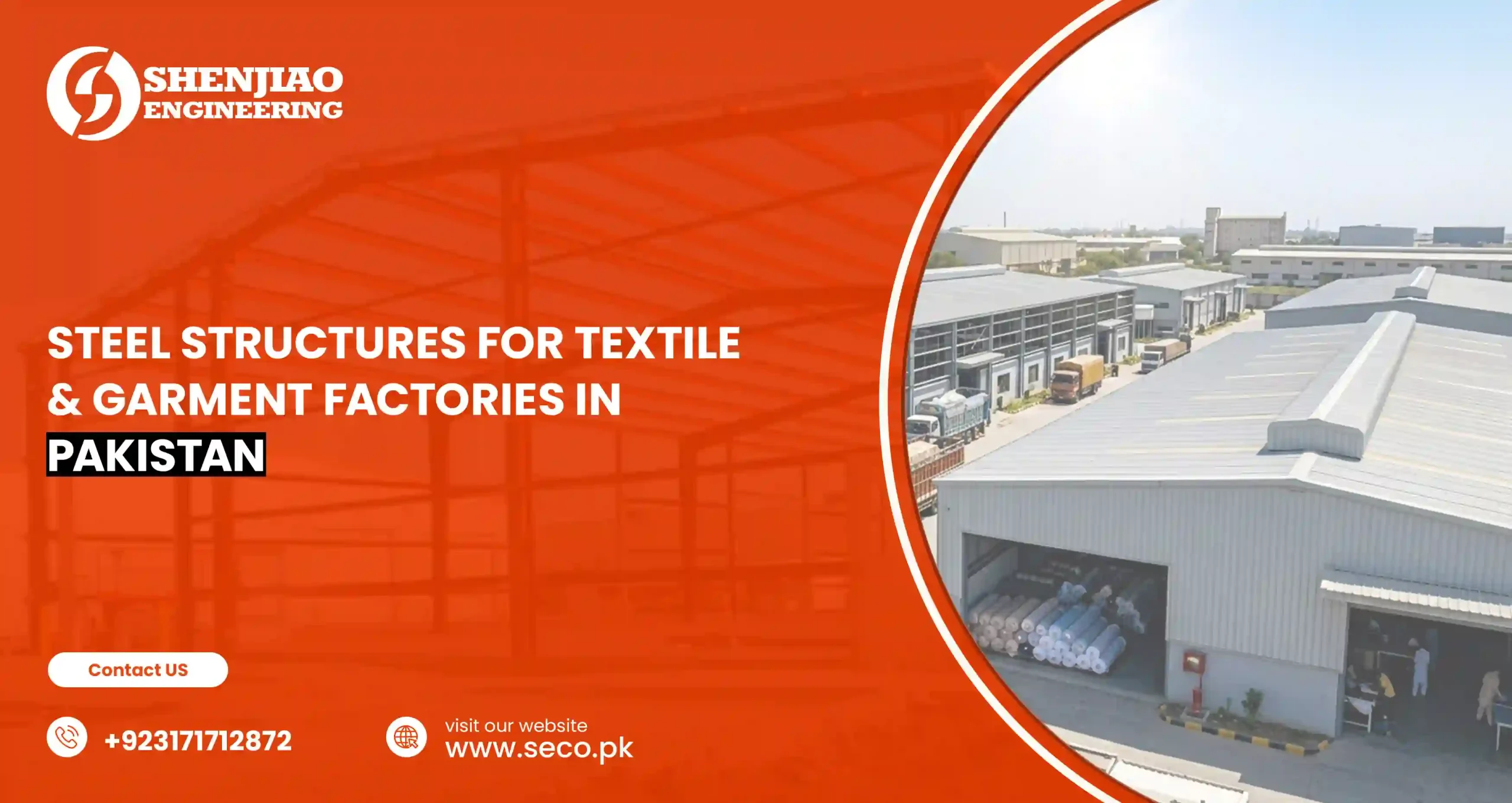
Steel Structures for Textile & Garment Factories in Pakistan
Introduction
Pakistan’s textile and garment sector remains the backbone of the country’s export economy, and the buildings that house spinning units, weaving sheds, dyeing plants, and garment stitching floors have to keep pace with production demands. Traditional concrete-frame construction often falls short when factories need large open floor areas, fast build timelines, and the flexibility to expand later. This is why more textile and garment manufacturers across Pakistan are turning to pre-engineered steel structures from SECO.
Why Steel Works Better for Textile Manufacturing
Large clear spans without interior columns. Weaving and stitching floors need open, unobstructed space for machinery layout and worker movement. Steel portal frame construction allows clear spans of 30 meters or more without a single interior column interrupting the production line, something conventional concrete construction struggles to achieve economically.
Faster construction timelines. A pre-engineered steel building is fabricated off-site while foundation work happens in parallel, cutting overall project timelines significantly compared to conventional construction. For a textile business under pressure to start production and fulfill export orders, that time saved translates directly into revenue.
Built for heavy equipment and vibration. Textile machinery, from power looms to dyeing drums, generates continuous vibration and mechanical stress. Steel structures handle these dynamic loads more predictably than masonry construction, reducing the risk of structural fatigue over the building’s lifetime.
Key Design Considerations for Textile Facilities
- Roof insulation: Dyeing and processing areas generate heat and humidity, making insulated roofing panels important for both worker comfort and energy efficiency
- Ventilation and natural lighting: Steel structures accommodate skylights, ridge ventilators, and turbo vents easily, reducing daytime lighting costs on the factory floor
- Future expansion: Steel buildings can be designed with expansion bays in mind, allowing a facility to add floor space later without redesigning the entire structure
- Fire safety compliance: Export-oriented textile units, particularly those supplying international retailers, often need to meet specific fire safety and building standards that a properly engineered steel structure can be designed around
Common Applications in the Textile Sector
- Spinning and weaving sheds
- Dyeing and finishing units
- Garment stitching and packaging floors
- Warehousing for raw material and finished goods
- Staff facilities and administrative blocks attached to the main plant
The SECO Approach
SECO works with textile manufacturers from concept through installation, handling structural design, fabrication, and on-site erection as a single coordinated process. Every project starts with an understanding of the client’s production layout, machinery specifications, and expansion plans, ensuring the final structure supports how the factory actually operates rather than a generic industrial shed design.
Conclusion
For textile and garment manufacturers looking to build faster, maximize usable floor space, and plan for future growth, pre-engineered steel structures offer a proven, cost-effective alternative to traditional construction. SECO brings the engineering expertise and fabrication capability to deliver these facilities on schedule.
Planning a new textile or garment facility? Contact SECO to discuss your project requirements.